Sauce Co-Manufacturing Checklist for Restaurant Groups and Cloud Kitchen Brands
Scaling a signature sauce is rarely a simple volume exercise. A chili crisp needs controlled oil separation. A tomato base needs repeatable body after heat treatment. A creamy dressing needs mouthfeel without drifting too thick for pumps, sachets, or squeeze bottles.
For restaurant groups and cloud kitchen brands, the right co-manufacturer should protect the sensory identity of the sauce while making it production-ready. That means clear specifications, pilot discipline, ingredient control, and a practical plan for viscosity, yield, stability, and repeatability.
LadleMetric supports sauce teams with R&D-led enzyme guidance for starch, fruit, vegetable, protein, and emulsion-adjacent systems. If you are comparing production partners, use this checklist to separate generic capacity from true formulation control.
1. Define the commercial job of the sauce
Before discussing kettles, filling lines, or minimum order volumes, document how the sauce will be used.
Confirm the use case
- Back-of-house finishing sauce
- Delivery bowl drizzle
- Dip cup or sachet
- Marinade or glaze
- Pizza, pasta, rice, or noodle base
- Retail-style bottle for direct-to-consumer channels
- Central kitchen ingredient for multiple menu builds
A sauce designed for a ladle station may not behave correctly in a pump, pouch, or cold-chain cup. The co-manufacturer should ask how the sauce is dispensed, heated, held, shipped, and consumed.
2. Lock the sensory target before the scale-up conversation
Your benchmark should not be described only as “thick,” “fresh,” or “premium.” Those words are useful in tastings, but they are not enough for production.
Build a sensory target sheet
Include:
- Appearance: gloss, color, visible particulates, oil sheen
- Aroma: fresh, roasted, fermented, smoky, dairy, citrus, spice
- Mouthfeel: cling, creaminess, pulpiness, smoothness, richness
- Flavor release: fast heat, slow heat, acidity lift, savory depth
- Texture behavior: pour, ribbon, dip, coat, spread, or glaze
- Finish: clean, oily, lingering, bright, or rounded
This target sheet becomes the reference point for pilot trials, ingredient swaps, enzyme selection, and shelf-life decisions.
3. Set viscosity targets by process condition, not just by sample cup
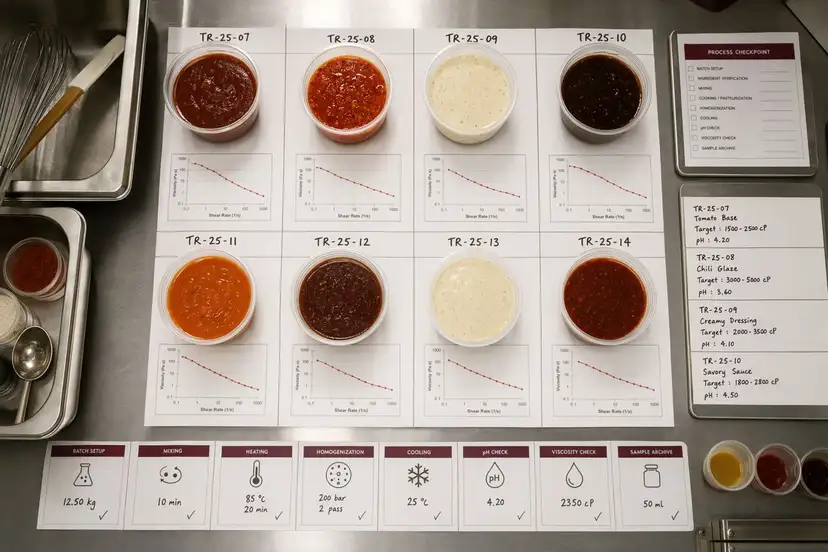
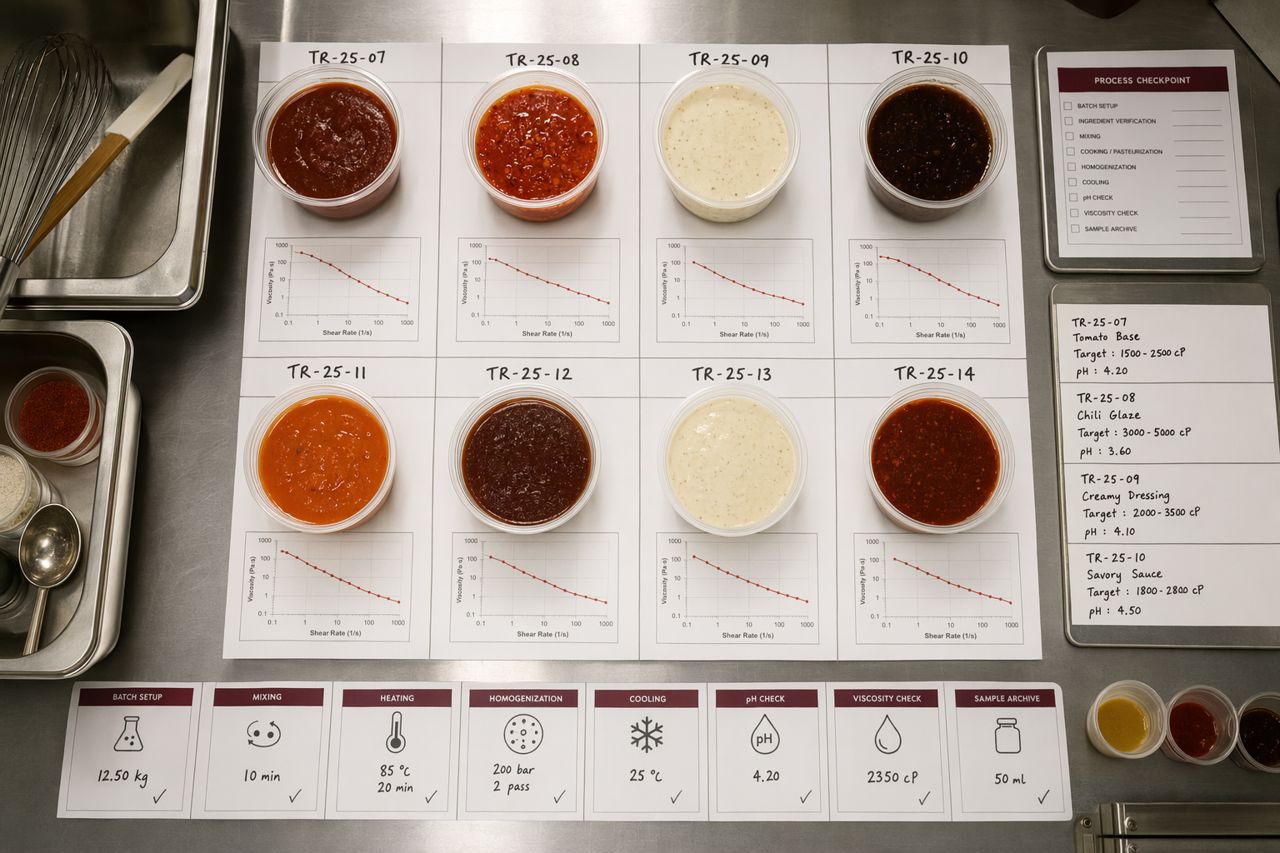
Viscosity is one of the most common failure points in sauce co-manufacturing. A sample can look right in a lab cup but fail after pumping, hot filling, cooling, freezing, thawing, or high-shear mixing.
Ask for viscosity checkpoints at these stages
- Post-mix
- After thermal processing
- After cooling
- After 24-hour rest
- After transport simulation
- At end-of-shelf-life target
- After reheating or service hold, if relevant
For starch-rich, tomato-rich, fruit-based, and vegetable-based sauces, enzyme strategy may help tune body, reduce processing drag, improve yield, or manage texture drift. The goal is not simply to thin or thicken. The goal is to hit the same eating experience at production scale.
4. Map the ingredient system before requesting a quote
A co-manufacturer can quote more accurately when the formulation logic is visible.
Document functional ingredients
- Starches, flours, pulps, purees, pastes, and concentrates
- Proteins from dairy, egg, soy, pulse, meat stock, or yeast sources
- Fibers and hydrocolloids
- Oils, emulsifiers, and acidulants
- Sugars, syrups, and reducing sugar sources
- Salt systems, preservatives, and flavor carriers
- Particulates such as chili flakes, herbs, seeds, garlic, onion, or inclusions
This is where an experienced food enzyme supplier for sauce manufacturing can support the technical conversation. The enzyme plan should match the substrate, process window, sensory target, and regulatory expectations of the finished sauce.
5. Verify co-manufacturer capability by sauce type
Not all sauce factories are equally strong across every format. A facility that runs smooth tomato sauces may struggle with particulate chili oil, high-acid dressings, nut-based sauces, or starch-thickened gravies.
Capability questions to ask
- Which sauce categories are currently produced on the line?
- Can the line manage particulates without settling or valve blockage?
- What filling formats are available?
- How is air incorporation controlled?
- What shear conditions are typical during mixing and transfer?
- Can the process protect volatile aromatics?
- How are hot-fill, chilled, frozen, or ambient formats validated?
- What cleaning changeovers are required for allergens, spices, colors, or oils?
A good partner will describe process limits clearly. A better partner will explain how formulation choices can be adjusted to work within those limits.
6. Build a pilot plan with decision gates
Do not move from benchtop approval directly to commercial production. Use pilots to test scale-sensitive behavior.
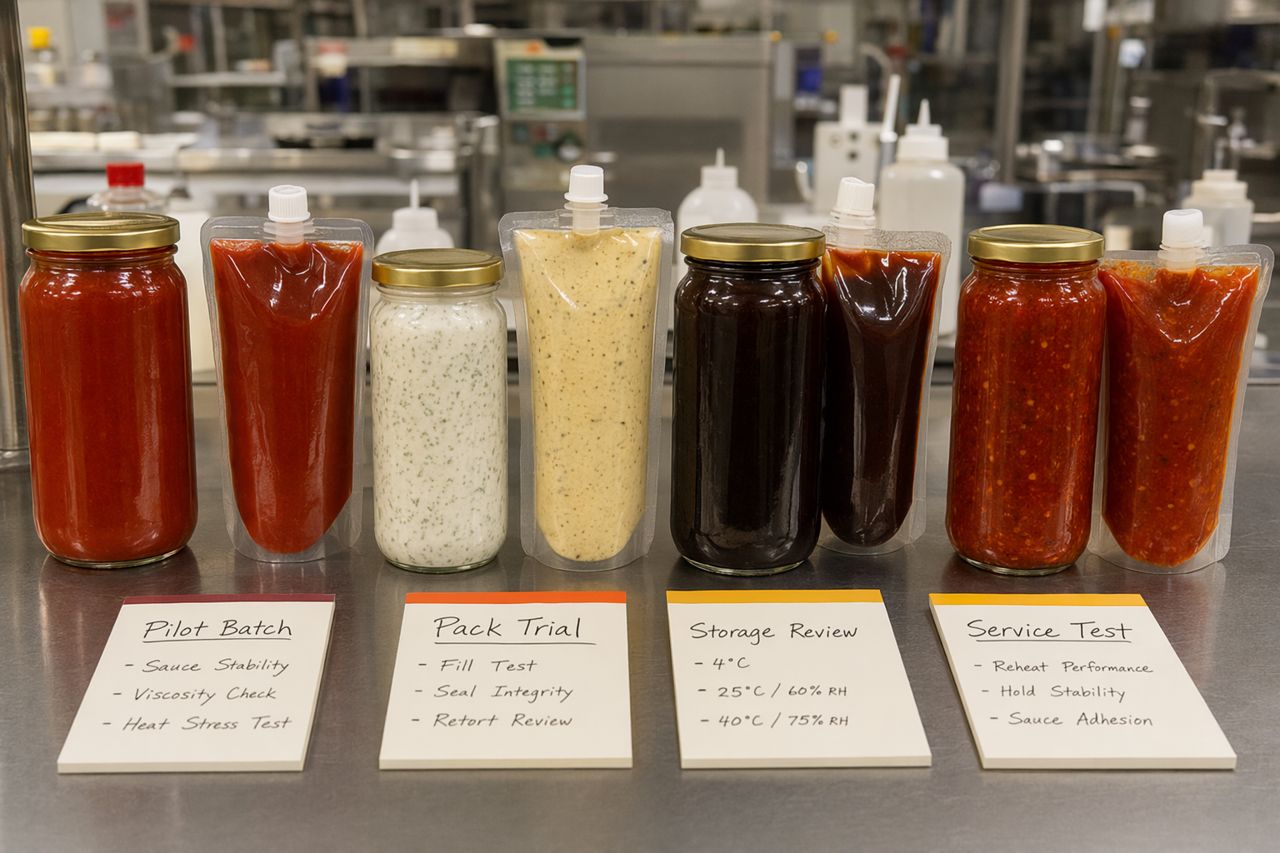
A practical pilot sequence
- Bench alignment: Confirm flavor, appearance, and initial texture.
- Process simulation: Apply heat, shear, hold time, and cooling steps that mimic production.
- Pilot batch: Run on representative equipment where possible.
- Packaging trial: Fill into the intended pack format.
- Transport and storage review: Evaluate settling, syneresis, oiling-off, color shift, and flavor drift.
- Service test: Reheat, pump, drizzle, dip, squeeze, or hold as the restaurant will.
- Cost review: Check yield, loss points, ingredient cost, and line efficiency.
At each gate, decide whether to adjust formulation, process, packaging, or the target itself.
7. Treat yield as a formulation metric
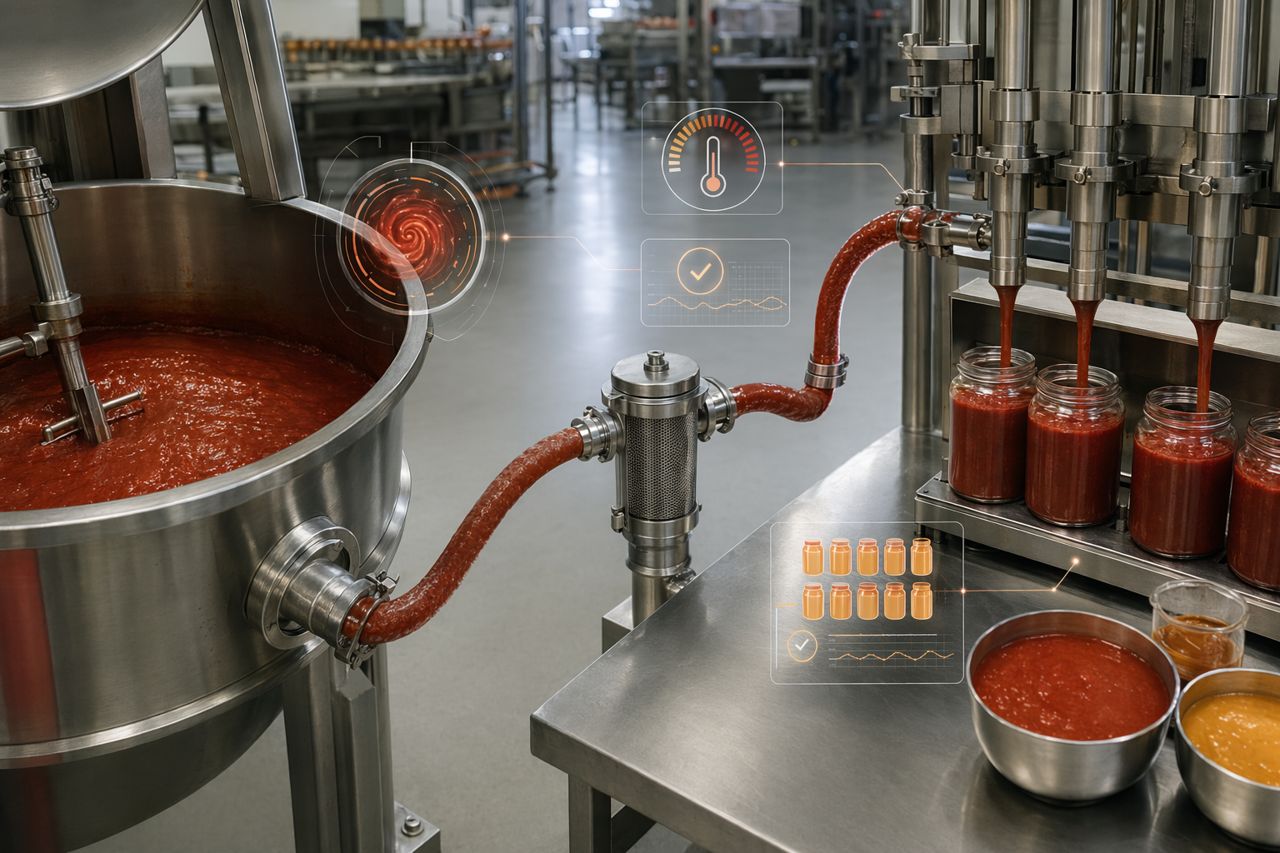
Yield is not only a procurement number. It is connected to hydration, solids behavior, filtration loss, kettle residue, transfer loss, and packaging accuracy.
Watch for hidden yield losses
- Pulp trapped in screens or filters
- Starch build-up on heated surfaces
- Product left in hoses after transfer
- Excess foam during filling
- Over-thick batches requiring dilution or rework
- Separation that causes inconsistent fill weights
- Particulates settling before final pack-out
Enzyme-enabled processing can sometimes improve extraction, reduce excessive viscosity, improve transferability, or stabilize texture around the intended target. The commercial value is smoother production and less avoidable waste.
8. Control stability without flattening the eating experience
Sauce stability should not mean stripping out character. The target is controlled separation, color retention, consistent pour, and the right mouthfeel at the point of use.
Stability checkpoints
- Phase separation
- Water release
- Oil ring formation
- Particulate suspension
- Color browning or fading
- Acid bite over time
- Spice bloom and heat migration
- Texture thinning or thickening during storage
- Pack compatibility
Cloud kitchen sauce programs often need repeatability across multiple production runs and multiple service locations. Stability testing should reflect the real distribution model, not only ideal storage.
9. Confirm documentation and change-control discipline
A co-manufacturer should be able to run your sauce consistently and document what changed when something moves.
Require clarity on
- Approved formula version
- Ingredient alternates and substitution rules
- Process parameters and hold points
- Packaging specifications
- Allergen control
- Batch records
- Retain samples
- Deviation handling
- Shelf-life protocol
- Sensory release criteria
If an ingredient, process step, or supplier changes, the impact on viscosity, flavor release, yield, and stability should be reviewed before the change becomes routine.
10. Ask how R&D support will work after launch
Many sauce programs evolve after launch. Menu teams add heat levels, regional variations, limited-time offers, lower-sugar versions, vegan formats, or new packaging. Your support model should account for that.
Useful post-launch support includes
- Reformulation for new pack formats
- Texture correction after ingredient changes
- Cost-down work that protects mouthfeel
- Heat-stability review
- Freeze-thaw or chilled-chain adjustment
- Yield improvement trials
- Troubleshooting separation, thinning, or filling variation
- Pilot support for new menu rollouts
A consultative enzyme partner can help your internal R&D team and co-manufacturer move faster, especially when sauce behavior changes under process stress.
Co-manufacturing checklist summary
Use this quick review before awarding a sauce production project:
- The commercial use case is defined.
- Sensory targets are documented.
- Viscosity is measured across process and storage checkpoints.
- The ingredient system is mapped by function.
- The co-manufacturer has relevant sauce-category experience.
- Pilot trials include process, pack, transport, and service testing.
- Yield risks are identified.
- Stability expectations are realistic and testable.
- Documentation and change control are agreed.
- Post-launch R&D support is available.
Where LadleMetric fits
LadleMetric works with sauce developers, restaurant groups, cloud kitchen brands, and production partners that need controlled texture and repeatable manufacturing behavior. Our role is to help connect formulation intent with scalable process reality.
As a food enzyme supplier for sauce manufacturing, we support technical decisions around enzyme selection, process fit, pilot design, and troubleshooting for sauce systems where viscosity, yield, mouthfeel, and stability matter.
Request a quote
Planning a sauce scale-up, co-manufacturing trial, or reformulation project? Share your sauce type, target pack format, process conditions, and current formulation challenge through the on-site request a quote form. LadleMetric will review the application and respond with a practical next step for your R&D or procurement team.